
Helium Recovery System
Recover More Helium. Reduce Operating Costs.
FullCryo USA provides integrated helium recovery systems designed to capture, compress, purify, store, and reuse helium that would otherwise be released into the atmosphere.
Helium is a valuable and limited resource. Facilities that use helium for manufacturing, research, medical, cryogenic, testing, and industrial applications can reduce helium purchases, improve supply security, and lower long-term operating costs by installing a properly engineered helium recovery system.
Turn Helium Losses Into a Reusable Resource
Many industrial and research processes discharge helium after use. Without a recovery system, this helium is often vented and permanently lost.
A FullCryo helium recovery system collects helium from process equipment and transfers it through a controlled recovery process. The gas can then be compressed, purified, stored, and returned to the original application or supplied to other helium-consuming equipment.
The result is a more efficient and secure helium supply system.
Main Benefits
Lower Helium Costs
Recovering and reusing helium reduces the amount of replacement helium that must be purchased from outside suppliers.
Improved Supply Security
An internal source of recovered helium helps reduce exposure to helium shortages, allocation limits, price volatility, and delivery delays.
Reduced Helium Losses
A properly designed collection and recovery system captures helium that would otherwise be released into the atmosphere.
More Sustainable Operations
Helium recovery conserves a finite and valuable resource by allowing the same helium to be used repeatedly.
Improved Process Reliability
Recovered helium can help maintain a more stable supply for production systems, cryogenic equipment, laboratories, and other critical applications.
Scalable System Design
FullCryo systems can be designed for an individual process, a single facility, or a larger centralized helium recovery network.
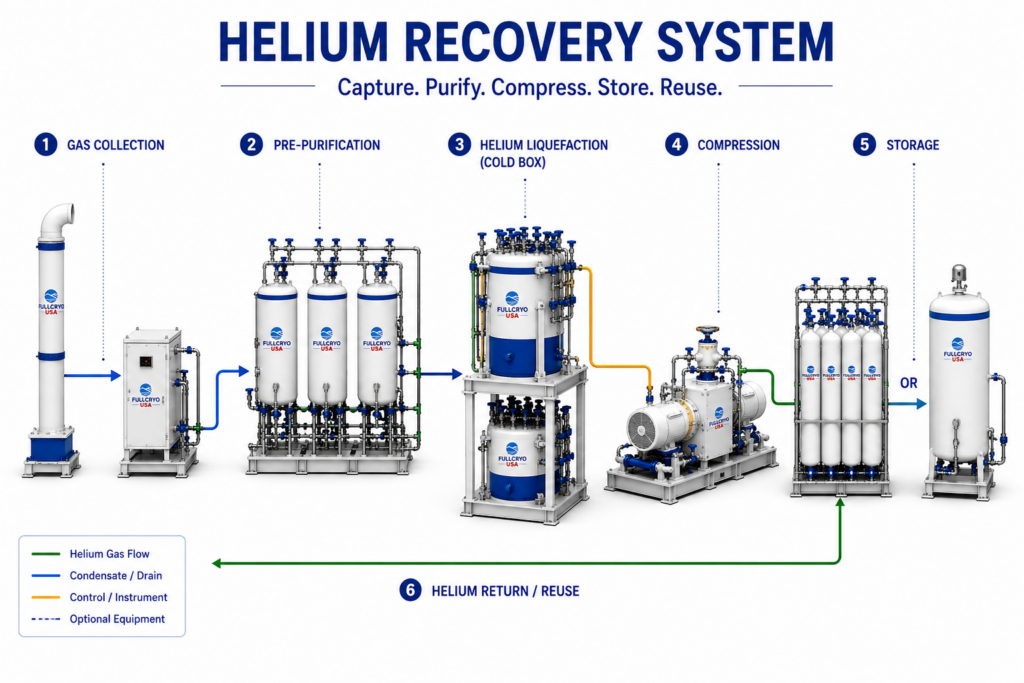
How a Helium Recovery System Works
1. Helium Collection
Helium is collected from production equipment, laboratory instruments, cryogenic systems, test equipment, or other helium-consuming processes.
2. Buffer Storage
Recovered helium is temporarily stored in a gas collection bag, low-pressure receiver, or buffer tank. This stabilizes variations in gas flow and pressure.
3. Compression
The recovered helium is compressed to the pressure required for purification, storage, or reuse.
4. Purification
Moisture, oxygen, nitrogen, air, hydrocarbons, and other contaminants are removed according to the required helium purity.
5. Storage
Purified helium can be stored in high-pressure vessels, cylinder banks, tube storage, or other engineered storage systems.
6. Reuse
The recovered helium is returned to the production process, laboratory, cryogenic system, or other end-use application.
Where required, purified helium can also be integrated with a helium liquefaction system.
Complete Helium Recovery Equipment
A FullCryo helium recovery system may include:
Helium collection piping and headers
Gas collection bags
Low-pressure buffer tanks
Helium compressors
Helium purification equipment
Moisture and contaminant removal systems
High-pressure storage vessels
Cylinder filling manifolds
Gas analysis instruments
Helium purity monitoring
PLC control systems
Remote monitoring capabilities
Safety and pressure-control equipment
Process piping and valves
Helium liquefaction system integration
Each system is configured according to the customer’s helium flow rate, inlet pressure, gas composition, required purity, storage capacity, reuse pressure, operating schedule, and available utilities.
Applications
Optical Fiber Manufacturing
Helium is commonly used in fiber draw towers and other optical fiber production processes. A recovery system can capture the discharged helium, remove process contaminants, and return the purified gas to production.
Research Laboratories and Universities
Helium recovery systems can collect gas from cryostats, superconducting magnets, analytical instruments, low-temperature experiments, and other laboratory equipment.
MRI and Medical Applications
Helium recovery can support applicable MRI service activities, magnet operations, helium transfer procedures, and boil-off management.
Semiconductor Manufacturing
Helium recovery systems can support helium conservation in cooling, leak testing, controlled-atmosphere processing, and specialized semiconductor operations.
Aerospace and Defense
Helium used for testing, purging, pressurization, leak detection, and specialized technical operations may be collected and reused.
Industrial Manufacturing
Helium recovery may be used in welding, leak testing, heat treatment, controlled-atmosphere processes, and other helium-intensive manufacturing operations.
Cryogenic Facilities
Recovered helium can be purified and returned to refrigeration, liquefaction, storage, transfer, and low-temperature systems.